Wednesday, December 18, 2013
The Merchant of Death
"The Merchant of Death" is the opening novel out of a series of ten in "The Pendragon Adventures," in which the main protagonist, Bobby Pendragon, essentially tries to prevent the destruction of the pathways between territories, or dimensions interconnecting the universe. This novel is written by DJ Machale, and was originally copyrighted in September of 2002. Technically, this book is classified as fantasy, but I would add it to the category of speculative fiction due to the fact that this book, along with the rest of the series largely revolve around science, Utopian and dystopian, and apocalyptic and post-apocalyptic fiction. From all of that, I would say that the general subject matter in this novel would be the fight for total control/power and how it affects society for the better or worse. Also it would be important to know that the antagonist in the story has almost every power you can think of. MacHale does a great job at his effort to make Saint Dane (the aforementioned antagonist) the literal Devil of the universe. The general plot in this novel focuses over Bobby Pendragon, a seemingly normal fourteen year old boy, and his travels between the territory/planet Denduron and his home Second Earth.Bobby is taken to Denduron with the help of his Uncle Preston, who fights for peace in the universe and is hoping that Bobby can help aid him with his efforts to prevent the oncoming civil war between the two different inhabitants of the planet...The Bedoowan and the Milago. One of the more focused themes in this novel is that power can corrupt the purest heart. I say this, because both the tribes on the territory Denduron are unreasonably corrupted from their fight for ultimate power, and control over one another.
The story is told from the words of the diary Bobby is forced to keep over the course of his journey(s). He writes these journal entries in first person format though. All in all, the style of narrative makes for an interesting, fresh sense of reading. The intended audience for "The Merchant of Death" and the rest of the series are mainly teenage boys, but the book would be very relatable to many teenage girls as well, due to a main female protagonists that accompanies Bobby throughout the book/series. As I said before, the general subject field that this novel is classified in is Fantasy, but I would also consider the book to fall on speculative fiction, and for the same aforementioned reasons. MacHale does a great job of keeping the reader interested by the his buildup of the plot. From the start of the book, he reveals that Denduron is on the verge of war, and as the story develops (rather quickly might I add) the two tribes grow closer and closer towards a bloodshed. In nearly every chapter, a new problem is introduced to the equation making the solving of the overall problem more difficult for Bobby and his alliances. MacHale uses a somewhat unique style of writing to help appeal to his intended audience. He writes this book with a very casual undertone for a book so largely based off the pressures of society, oncoming war, and the fight for domination. Also you uses lots of comical/humorous dialect between characters to help the reader relate to the story. Personally I thought his writing style was very effective, due to the fact that it was simply unique, but done so with the careful precision to eliminate any sort of estrangement the reader might've felt while reading the novel.
Honestly, this book didn't challenge me in any way to think differently about something/anything. I felt no change in thought about what is going on in my life due to reading this book. Part of the problem with books about speculative fiction is that they are difficult to tie into reality due to the fact that they are, well, speculative. This novel kind of reminded me of Stoneheart in the fact that there is a lot going on all throughout the story at the plot continues to intensify when you think it can't anymore, until the end of the book.
Honestly, I liked the book, largely because of the unusualness of the plot line, and the ideas the story focuses on in general. The book was well written, and I was impressed by how MacHale captured the essence of thought coming from Bobby with the narrative coming from the format of a journal. I would recommend this book to somebody who enjoys long series, and who enjoys lots of "time continuum-type" novels...focusing on the fabric that is time and space. I would not however recommend this novel or series to anybody who doesn't enjoy science fiction, because that there is a lot dialect and thought based around how the story/journey is possible.
Steven Ø'Connell
12/17/13
Rating *** 3/5
Miss Peregrine's Home For Peculiar Children- Ransom Riggs
The author of this prodigious fictitious novel, Miss Peregrine's Home For Peculiar Children, is the one and only Ransom Riggs. This novel was published in June of the year 2011. The novel reveals the tale of a boy who, following a horrific family tragedy, follows clues that take him to an abandoned orphanage on a Welsh island. The novel is told through a combination of narrative and indigenous photographs from the personal archives of collectors listed by the author. Jacob Portman is 16 year old teenager, living in Florida and suffering from incurable heedlessness . One bright spot in his life is his Grandpa heedlessness, an elderly man with a dark and maybe sinister past and an odd collection of old photos. When Grandpa Portman is tragically murdered, the police say a pack of feral dogs killed him. Jacob, though, saw the beast that did the deed. It was a monster, just like the one Grandpa Portman had claimed was chasing him – the very same story Jacob had grown to disbelieve. Motionless about his grandfather's death, he is now in search of an answer. After reading this tale, I believe the overall theme is to really watch out for life changing decisions, they may just alter your current lifestyle into something unimaginable.
The story is told in the first person point of view. It all begins when Jacob Portman's grandfather is murdered for what he believes are the dark monsters of the unknown. That specific event leads Jacob to a trans of confusion and suspicions on his behalf. He easily convinces his father to take a trip to a Welsh island for "bird watching". Once they arrive, Jacob notices that everything and everyone there is so strange. Their personality is just not normal. That unravels the curious Jacob into discovering his grandfathers past as an orphan. The intended audience for this book are mainly for young adults because this really makes you realize that once we get older decision making gets tougher. I believe this novel falls into the category of Historical fiction and mystery for young adults. This book is breath taking to me because I LOVE novels that are mysterious and have just a hint of horror, which the climax of those type of novels is way more interesting than any other bland book.Moving on,The photographs are tucked into the pages as illustrations. While you read, it feels like the author has allowed the photos to steer the narrative into the "right" direction. This makes the novel seem like an adventure. While it sounds odd to admire an author of a fantasy book for exploring, I refer more to the process of a writer opening himself up to things beyond his control. It is a risk to allow an object to pull the story off a plotted path. And it is precisely this risk that rewards the reader. Last but not least, I noticed that the author has a very unique way of capturing the authors attention. He uses such old vintage photographs at play. The author’s ability to use the photos to play with the reader’s imagination, while still holding the tension of the plot, is extraordinary. This kind of attribute can feel like a self-conscious reminder of the authorial hand. But in this case, the use of found art is an elegant tool that reinforces the message of the book. This is a very positive effect of grasping the intended audience's attention.
And then I wonder: is it the role of grandparents, themselves, that is used to introduce mystery and magic into modern day American tales, or is it simply the immigrant tale itself? There is still a kind of mystique to immigrant culture, or so it appears in contemporary American literature. There is some kind of an assumption that the immigrant brings with him/her magic or old traditions from their countries that don’t exist in America. This novel really made me think of a few questions just out of curiosity. This book also made me realize that should really not be looking forward to adulthood. This by far has been the uniquest book I've ever read.
This book could have not been better at all! It has a little bit of everything.I would recommend this book 100% to be read completely, because you will enjoy every second of it!
Chelsea C.
12.18.2013
Rating:***** 5/5
My book is called Uglies by Scott Westerfeld. It is a science fiction book that was first copyrighted in 2005. The book is about a girl named Tally who always dreamed of becoming a pretty. When Tally meets Shay, she learns that being pretty isn't the most important thing. The theme of the book is that looks aren't as important as your personality.
Uglies is written in third person point of view, which helped me understand the plot better. The book takes place in the future, where on your sixteenth birthday, you got an operation that would turn you pretty. Tally always wanted to become pretty until she met Shay, who taught her that she was pretty the way she was. Shay taught her about a place called the Smoke, where people could live without getting the operation. However, after living in the Smoke for a while, the government finds and captures many of the people living there. They capture Shay and turn her pretty, and Tally finds that the only way to save her is to become pretty herself. The intended audience of the book is people that are my age, thirteen or fourteen. The book is science fiction, and you can know this by the strange medical technology that is not used today. There are also things like hovercars and hoverboards that give away the genre. The author's style was to use cliff hangers and suspense to keep me interested, and it worked very well to keep me reading.
The book affected me by making me surprised when Shay and Tally became pretty, and it made me and other readers realize that being pretty wasn't important. Uglies did not change my views very much, because although I did see other people as pretty, it wasn't ever important to me. This book reminded me of Divergent, by Veronica Roth because in both books, the main character differed a lot from what society wanted people to be.
Overall, Uglies was a very good book and I would definitely recommend it. I liked the action that occurred in the book. I also really enjoyed the very different characteristics of each person in the book, and how one character could be the complete opposite of the other. This book was great and I recommend it for anybody who likes action books that occur in the future, like The Hunger Games or Divergent.
Jamie J
12/18/13
**** 4/5
Blade of Tyshalle was written by Matthew Strover as a sequel to Heroes Die. This sci-fi fantasy novel was published April 3, 2001. At the end of the last book, Harry Michelson, also known as Caine, was stabbed by his enemy, causing him to loose control of his legs. He works as an executive for the studio he used to work for. His old school friend Chris Hansen sends him a message from over-world (another dimension used for the "studio" as a place for actors to go and record their adventures for others to watch) that HRVP (a genetically enhanced version of Rabies) has erupted. Harry must save over world while discovering how the outbreak was planned to colonize Over-world while still saving his wife and child. The overall theme of the book is that you don't know how things will work out, all you can do is try to achieve whatever you are trying to achieve.
The story is told from Harry's point of view as he watches his life unravel at home. He finds a plot to kill his wife on over-world, his daughter is taken from him, and his Dad is put under the yolk (cyborged for labor). Harry has to return to over-world as a cripple, watch his wife (Shanna) killed and be captured by his old enemies before his epic battle with the old god, Ma'elkoth. While this story is mainly science fiction fantasy, is is riddled with philosophy and the major elements of the book are wrapped around the philosophical statements that Strover makes. Strover keeps you reading with constant plot twists and the unraveling mysteries that make up his world. The style is unlike to what I have read before as it brimming with curses and violence, yet there is philosophy at every turn. This is one of a kind as far as the books I have read. Blade of Tyshalle is definitely meant for an adult audience.
I was appalled at times to the violence and at some of his ideas about mankind. He refers to the Blind God, or the God of Dust and Ashes, which is the god of human nature. While there are many gods on over-world there is only the one left here. It is the real antagonist in the book as it takes over the minds of the other antagonists. At the end of the book Strover attempts to summarize the meaning of life as nonexistent. I found many of the things he talked about to be very interesting and disagreed with some, but this is as it should be. Many of the ideas discussed, where beliefs that I already held. Blade of Tyshalle and its prequel are unlike other books I have read.
Blade of Tyshalle has many plot twisting mysteries and philosophical ideas that are unlike other books. Although it has much unnecessary violence, the themes in this book are quite amazing. I recommend Blade of Tyshalle to any one who likes a good plot or philosophy, but do beware of the violence included.
Amber Carlson
12/18/13
***** 5/5
Tuesday, December 17, 2013
The Invention of Hugo Cabret

I have recently been reading a book called The Invention of Hugo Cabret by Brian Selznick. The copywright date of the book is June 2, 2008 and it is a mystery book. It is a fiction story about a little boy named Hugo who lives in the wall of a train station and everyday he wakes up to go and mend the clocks. He later is given an automaton which is suppoed to work but it doesnt. Throughout the book he is trying to figure out to make the automaton work until he finds this key... The overall theme of the book is to never give up.
The book is told in 3rd person point of view. The story is about a boy who lives on his own in the walls of a railroad station. Everyday he gets up and mends the clocks to keep them going. Throughout the story he faces challenges and he manages to get around them. The intended audience are mainly kids and small children. The genre of the book is fiction and the book fits me because I remember a time that I never gave up just like Hugo. The author keeps me interested because I always wanna find out what happens next to Hugo and his life. I think that the authors style is effective because there are some very god pictures in the book that expin to the audience what is going on.
The book affected me because it taught me that even when times are hard and frustrating, you can never give up and have to keep going. It fits into my world view because when Hugos dad died I can relate to that when my Grandpa passed away a few years ago. It was hard and very sad but I knew that couldnt keep me from doing what i needed to do. This book did not bring up any memories from other books that I have read because this book is different from other books.
I would like to acknowlege how the author did a really good job using good detail and explaining everything very well. I would recommend this book to anyone who likes to read books that are long and have alot going on.
Peyton Zachry
Mr. Lankford
12/17/13
***** 5/5 stars
Catching Fire
Catching Fire by Suzanne Collins is the second book in the Hunger Games series. It was published on September 9th in 2009. The first book in this series is called The Hunger Games. The third, and final book is called Mocking Jay. The book starts off talking about Katniss' (the main character) life after the games.(The Hunger Games) It then talks about everything Katniss has to deal with up until the next Hunger Games. This year would be the 75th anniversary of the hunger games. It talks about how she gets through it.
The genre that I would put this book in is the Science Fiction genre. I would put it in this genre because it has a lot of futuristic ideas that I have barely even heard of and because it has the idea of the United States collapsing and that Panem (the country in which they live) was built on the ruins of the old United States. I would say that this book would be intended for anybody above the age of seven and under the age of twenty-two.
This book affected me in a different way because it didn't really make me look at the world differently or make me re-think any of my choices, it just made me want to do archery way more than I used to. This also just made me want to write more. It didn't make me think of any other book. I just thought it was awesome.
I loved this book! I saw the movie. I have read the whole series twice. Best book I have ever read. I don't care if some people don't agree with me, but this is an amazing book. I recommend this book to every thing alive and dead. Seriously, read it to your dog or your pet parrot named Pete or the tree in your backyard or even the mice in your streets. It is a favorite of mine. It is great.
Isabella Alvear
12/17/13
RATING: ***** 5/5
The Meowmorphosis Book Review
The book I read is called The Meowmorphosis, and is written by Coleridge Cook. It was published in 2011, and was written as a new version of The Metamorphosis, written by Franz Kafka. A man named Gregor Samsa woke up to find he is a cat. He then leaves his family and learns a internal lesson that involves him not standing up for himself to have his own life, and freedom from having to pay off his fathers debt. The theme of this book is you shall have no life of your own if you continue
to work for someone else, so forge your own path, and have freedom.
The story is told by the author, describing Gregor's thoughts and feelings, in 3rd person. It is told from the moment he wakes up, and discovers he has four legs. The intended audience is for college students or higher, and it is a philosophical book, with a little bit of dark fantasy tied in. The book fits into those genres because it is about morals of Gregor, his role he plays/should play in life, and also he turned into a fluffy kitten. Also he had encountered some cats which took him away to his trial in court, and Gregor was quite sluggish as a cat, almost like a stereo-typical zombie. Coleridge keeps the reader interested by having Gregor taken against his will, and also penetrating deeper into his thoughts and his life with his family. Also the authors style is to make it seem that you are experiencing all of the troubles Gregor is having, and that you are there with him. That style is very effective for the readers, because it keeps them engrossed in the book, and it gives more insight about all the different events happening in his life that tie into the worst problem- his lack of freedom.
This book effected me by making me think of how some people are so unfortunate to the point where they too are in debt and must slave for the entirety of their lives, just to help pay off some money they owe, therefore dooming further generations into slaving away their lives, instead of choosing the path they would wish to take. I am more fortunate however, and am able to make my own choices, and determine what I would like to do. Because of this book I now am more thankful of the fact that I may do what I please once I am older, and that I don't have to work to pay back money to others. The Meowmorphosis brought back memories of another book I have read, The Curious Incident of the Dog in the Night-Time, because both books are told very specifically from the main character's point of view. Plus the autistic boy in The Curious Incident chose what he wished to do, whereas Gregor was forced to pay money instead of doing what he wished.
I loved the way the author described everything in detail, for it seemed you could experience Gregor's life alongside him, or as him. Plus it was a philosophical book, and even though the mood was quite solemn, it still was very enjoyable because it made you wonder about Gregor's role in the world and whether he was going to/meant to change it. I recommend this book for anyone who reads at a college level or higher so as to understand the complex themes more in-depth. Plus if you ever read and enjoy this book, it would be best to read the original to which it was based off of, The Metamorphosis.
Sarah Willmann Dec 17, 2013 4.5 */ 5*
The Secret Life of Bees
The Secret Life of Bees, with first copywrite
in 2002, is a coming-of-age novel
written by Sue Monk Kidd.
Throughout the story, you follow the
dramatic life events of a 14-year-old girl named Lily Owens. When you’re introduced
to Lily, she’s motherless and desperately searches for her, she searches for
a mother who would guide her and love her. She would do so as if she was
looking for something to wear, searching in her dark closet extending her arms
forward and groping aimlessly for the skin that would make her comfortably
alive.
You follow this girl through tragedies and
insecurities as she tries to gather understanding of people and the world, but
ultimately, you follow her through the defining of her character and the
struggle of developing her identity as she copes without a loving figure to
guide her.
The
story is told in first person, from Lily’s point of view.
The book starts off by introducing Lily
and her life as she’s come to know it. She discusses the tyranny of her father,
Terrance Ray Owens, or T. Ray for short and the strained relationship they have
that you find out is result from the loss of her mother, Deborah Fontanel Owens.
The main cause for Lily’s troubles is that she accidentally killed her mother
when she was just four, but later on in life she realizes that a mother is all
she ever wanted, someone to relieve the misery of having no friends and
practically being confined with her awful father who persists on taking away
everything she comes to love. She’s so strung up about that fact that she
doesn’t know whether to believe it or not and it causes an overall
discombobulating of her life. Eventually, she runs away with Rosaleen, their
housekeeper, who is the only source of love in her life besides a picture of
her mother and her mother’s things. One of her mother’s things is a picture of
a black-skinned virgin Mary pasted to a block of wood that has the words,
‘Tiburon, SC” written on the back of it. Lily thought that, since it was her
mother’s thing, her mother must have been to Tiburon, South Carolina which was
just a couple of hours from her own town. So Lily and Rosaleen took off to
Tiburon and found their way into the arms of three black sisters, August, June,
and May Boatwright who all live in one pink house where they make honey for a
living. The label on the honey jars they make was the same picture she had of
the black Mary, which led Lily to think that her mother had stayed with the
Boatwright sisters. Rosaleen and Lily stayed there for a while learning about
honey, the black Mary and falling in love with life and the sisters. Although
after a while, T. Ray found Lily and confronted her.
I think the author intended the audience
to be young people around Lily’s age since the book deals with problems dealing
with discovering and building identity that most teenagers would also have
problems with and this book serves as a guide for those young people.
The
Secret Life of Bees is
an American coming-of-age novel. I would say it fits into my life because the
moral of the story is good reminder of how to live life in a way that makes you
happy and that’s something that I usually need to be reminded of.
This book is definitely a page-turner, I
assigned a prescribed amount of pages I would read a day to finish on time and
I finished ten days early! The story sucks you in and really gets you invested
in Lily’s life because the author created a situation that everyone an relate
to in their own way and interesting circumstances that story takes place in.
The author’s style is quite natural and,
honestly, refreshing, you get the impression that Lily’s heart is just open, or
rather, wants to be. The inferences she makes about her surroundings are unique
and interesting and the way she delivers them are interesting as well. You can
tell that the author has inserted her own views about the world into Lily’s
character. The way she wrote was very natural and easy, but also intriguing and
innovative and it’s definitely appropriate for the intended audience.
The book affected me in that it’s
nostalgic for me because I have a similar situation with my parents in that I
don’t really have any parents and in that way, I connected with it on a personal
level.
This novel serves as a wonderful guide
for young people who are lost like Lily was. The story is accessible, but also
different enough to be interesting and has enough of a moral to be meaningful. I
found that, the book itself and its story becomes that missing mother for all
the lost youths of the world.
This story is similar to other works I’ve
come to know in that it has a significant moral relevant to life.
I don’t agree with some of the story choices
the author made, they seemed to cheapen the overall good impression of the
book, although The Secret Life of Bees is
just a good book and I don’t think anyone could not like it.
Cadence Gorman
12/16/13
RATING: **** 3.8/5
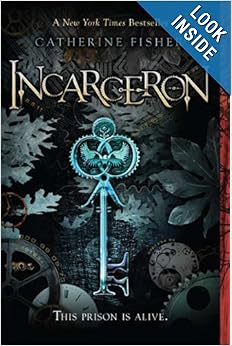
Incarceron
This six weeks I read Incarceron by Catherine Fisher. Copyrighted in 2007, this is a science fiction story that is based off of a futuristic prison. The story is mostly about two main characters. One of them is a boy named Finn who lives inside of Incarceron, the prison that is alive. He claims to have come from the Outside, and has visions of what he believes to be the past every once in a while. The other main character is Claudia. Claudia is a girl who lives in the Outside, where the era has been reduced to the 18th century and technological progress is forbidden. The two each find a key which allows them to communicate with each other, and together they try and release Finn from the mysterious prison in order to prevent Claudia's arranged marriage.
The story is told in a third person point of view, switching from revolving around Finn to Claudia, and at one point even gets to Jared, Claudia's tutor. In the book, Finn obtains a crystal key in his dreams, and Claudia obtains an identical key after sneaking into her father's study. The two use the keys to speak to speak to each other, and Claudia attempts to help Finn escape. Finn attempts to find the portal out of the prison with his oath-brother Keiro, Gildas the Sapienti, and Attia, a girl who was rescued by Finn in his attempt to escape the Comitatus. Claudia, on the other hand, is doomed to an arranged marriage, and is trying to let Finn escape since she thinks he is Giles, the young prince who died many years ago. Claudia is aided by Jared, her Sapienti tutor, and together they try to sneak around her father, who is the warden of Incarceron, in order to find clues to help Finn escape. In the end, Claudia's father finds out about the attempted escape and decides to help them out in the process. The intended audience is probably people around 13 to 15 years old, due to all the violence and deaths and such. The book is a science fiction book, and this is mainly because although regulations disallow modern technology, there are quite a few science fiction parts to the book, such as Jormanric's rings that allow him to live multiple lives and the prison itself, which contains thousands of lives, is really a small silver cube on the warden's chain. The book keeps you interested by having a lot of conflicts for the main characters, and a new one appears almost instantly after one is solved, so you'll want to know what happens next. Fisher's style is one that goes into detail and helps put things into your head without making the book too long.
The book did not really affect me that much. The book barely relates to pretty much anyone in today's modern world, because even though it's the future regulations keep things in the 18th century. It does make you think a little more about pain and suffering. People may think that their lives suck, but in this book it's a lot worse. Claudia finds out that the Warden isn't actually her father, but she was adopted from the prison. Evian, one of the characters in the story, ends up killing himself after failing to murder the queen. Finn thinks that he used to be Giles, the prince, and got put into Incarceron because the queen was blackmailing the Warden. This book doesn't really remind me of anything else, it is unlike any book I have ever read.
The idea of a living prison and escape may sound a little odd or maybe even overused to you, but the way Catherine Fisher puts it makes it one of the best books I have ever read. The way the book keeps one conflict going after another made it difficult to put the book down. Overall, this is a great book and I would recommend this to almost anyone, friend or foe.
Bill Dang
12/17/13
RATING: ***** 5/5 Stars
The story is told in a third person point of view, switching from revolving around Finn to Claudia, and at one point even gets to Jared, Claudia's tutor. In the book, Finn obtains a crystal key in his dreams, and Claudia obtains an identical key after sneaking into her father's study. The two use the keys to speak to speak to each other, and Claudia attempts to help Finn escape. Finn attempts to find the portal out of the prison with his oath-brother Keiro, Gildas the Sapienti, and Attia, a girl who was rescued by Finn in his attempt to escape the Comitatus. Claudia, on the other hand, is doomed to an arranged marriage, and is trying to let Finn escape since she thinks he is Giles, the young prince who died many years ago. Claudia is aided by Jared, her Sapienti tutor, and together they try to sneak around her father, who is the warden of Incarceron, in order to find clues to help Finn escape. In the end, Claudia's father finds out about the attempted escape and decides to help them out in the process. The intended audience is probably people around 13 to 15 years old, due to all the violence and deaths and such. The book is a science fiction book, and this is mainly because although regulations disallow modern technology, there are quite a few science fiction parts to the book, such as Jormanric's rings that allow him to live multiple lives and the prison itself, which contains thousands of lives, is really a small silver cube on the warden's chain. The book keeps you interested by having a lot of conflicts for the main characters, and a new one appears almost instantly after one is solved, so you'll want to know what happens next. Fisher's style is one that goes into detail and helps put things into your head without making the book too long.
The book did not really affect me that much. The book barely relates to pretty much anyone in today's modern world, because even though it's the future regulations keep things in the 18th century. It does make you think a little more about pain and suffering. People may think that their lives suck, but in this book it's a lot worse. Claudia finds out that the Warden isn't actually her father, but she was adopted from the prison. Evian, one of the characters in the story, ends up killing himself after failing to murder the queen. Finn thinks that he used to be Giles, the prince, and got put into Incarceron because the queen was blackmailing the Warden. This book doesn't really remind me of anything else, it is unlike any book I have ever read.
The idea of a living prison and escape may sound a little odd or maybe even overused to you, but the way Catherine Fisher puts it makes it one of the best books I have ever read. The way the book keeps one conflict going after another made it difficult to put the book down. Overall, this is a great book and I would recommend this to almost anyone, friend or foe.
Bill Dang
12/17/13
RATING: ***** 5/5 Stars
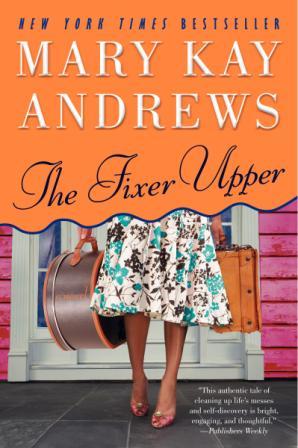
The Fixer Upper - Mary Kay Andrews
The narrator of the story is in the third-person point of view. I don't like that at times because sometimes i would like to see what other people are thinking but can only see what Dempsy is thinking. The plot revolves around the idea of Dempsy being interrogated and accused of having to do with the scandal while she is away attempting to not only fix up the house but to patch up her life. The story slightly suggests things like don't trust anyone but then kind of changes it to try to not be naive.
I think the book didn't impact me very much. It kind of made me want to be a little less naive or something but didn't really change anything. The book didn't teach me a great lesson like I have a nice life compared to some people and maybe i should appreciate it but just slightly added to the don't judge a book by it's cover that we experience in everyday life.
I didn't like this book very much and it kind of was extremely predictable obviously in the end everything would work out and that's great and all but there were no surprises thrown into the book. No huge difficulties or nothing that didn't really go her way. This book has language and other stuff not suitable for people who are immature so i would not suggest this book to most middle schools. Additionally this book was not great so I would not suggest it to most people.
Emma Garza
12/27/2013
Rating: 1/5
Allegiant by Veronica Roth

Allegiant by Veronica Roth is the final book in the young adult science fiction trilogy, Divergent. The copyright date was October 22nd, 2013 and is about a teen Tris Prior and her friends as they rebel against the authority that divides them. In the beginning of the series, Tris lives in a world where you have to choose to live in one of five factions: Abnegation (the selfless), Candor (the honest), Erudite (the intelligent), Dauntless (the brave), and Amity (the kind). Eventually by the third book, Tris is living in a world where the inequality and discrimination she finds is between people labeled genetically pure and people labeled genetically damaged. There are "tests" placed in the world to cure people of being genetically damaged but much like the Chicago test where Tris and her friends escaped from, they usually fail. The final book is about rebelling against titles that separate the community and world. The overall theme of the book is to always fight for equality, and to always be thinking of the greater good.
The story is told through first person point of view, alternating between Tris and her boyfriend Tobias. The book begins with Tris and a group of friends escaping Chicago, their test city, and making it into the outside world. They discover a government research facility that monitors Chicago that takes them in and discover that life outside of the city isn't necessarily better than inside it. The government tells them about tests to see if they're genetically pure (normal people), or if they're somehow genetically damaged from a genetic war in the past. When everyone but Tris discovers that they're "genetically damaged" it upsets them, especially Tobias. While he struggles with coming to terms with being genetically damaged, he becomes cohorts with rebels inside of the government facility, along with Tris and her friends. Though some things go wrong with the group, they end up making the world a better place for equality through sacrifice and forgiveness. This book is intended for audiences around 13-18 and it fits into the science fiction genre because of it's futuristic dystopian setting where genetic warfare has dramatically altered the world we know now. The author uses constant dramatic plot twists and heavy foreshadowing to keep the reader anticipating and interested. The style the author uses seems somewhat distant at first, but becomes more engaging as you read on, making you become more attached to the characters and more affected by the traumatic events of the book which I believe is fitting for teens.
This book taught me the importance of sacrifice and working for a common goal, not in self-interest. However, it did leave me pretty gloomy after the end. The end made me feel like we, as people, can never get a solid happy ending, and the book left a bitter sweet feeling in my mind for days. Allegiant made me feel how important it is to live life in the moment and to take action, when before I would've felt more timid. To me, the heroic actions in the book struck home, and connected well with my personal views on how to go about life. Single choices can change your life forever. Allegiant reminded me of another extremely popular science fiction trilogy The Hunger Games because of the similar traits in the heroines and the dramatic life changes they endure.
Overall, I thought that Allegiant was an interesting close to the Divergent series. However, with every turn I wanted it to be going in a different way. I accept that happy endings aren't realistic, but some of the plot points were dissatisfying to me. But still, I would recommend the book because it's well written and the themes of forgiveness and sacrifice are themes that need to be shared.
Mary White
12/17/13
RATING: *** 3/5
The story is told through first person point of view, alternating between Tris and her boyfriend Tobias. The book begins with Tris and a group of friends escaping Chicago, their test city, and making it into the outside world. They discover a government research facility that monitors Chicago that takes them in and discover that life outside of the city isn't necessarily better than inside it. The government tells them about tests to see if they're genetically pure (normal people), or if they're somehow genetically damaged from a genetic war in the past. When everyone but Tris discovers that they're "genetically damaged" it upsets them, especially Tobias. While he struggles with coming to terms with being genetically damaged, he becomes cohorts with rebels inside of the government facility, along with Tris and her friends. Though some things go wrong with the group, they end up making the world a better place for equality through sacrifice and forgiveness. This book is intended for audiences around 13-18 and it fits into the science fiction genre because of it's futuristic dystopian setting where genetic warfare has dramatically altered the world we know now. The author uses constant dramatic plot twists and heavy foreshadowing to keep the reader anticipating and interested. The style the author uses seems somewhat distant at first, but becomes more engaging as you read on, making you become more attached to the characters and more affected by the traumatic events of the book which I believe is fitting for teens.
This book taught me the importance of sacrifice and working for a common goal, not in self-interest. However, it did leave me pretty gloomy after the end. The end made me feel like we, as people, can never get a solid happy ending, and the book left a bitter sweet feeling in my mind for days. Allegiant made me feel how important it is to live life in the moment and to take action, when before I would've felt more timid. To me, the heroic actions in the book struck home, and connected well with my personal views on how to go about life. Single choices can change your life forever. Allegiant reminded me of another extremely popular science fiction trilogy The Hunger Games because of the similar traits in the heroines and the dramatic life changes they endure.
Overall, I thought that Allegiant was an interesting close to the Divergent series. However, with every turn I wanted it to be going in a different way. I accept that happy endings aren't realistic, but some of the plot points were dissatisfying to me. But still, I would recommend the book because it's well written and the themes of forgiveness and sacrifice are themes that need to be shared.
Mary White
12/17/13
RATING: *** 3/5
Flawed Dogs
Lets face it, we almost always stay away from stories about dogs, we don't want to get depressed over a dog getting hurt or passing away, but the book Flawed Dogs is a great suspenseful story. Flawed Dogs was written by Berkeley Breathed and its copyright date is in 2009. The book is about a dachshund named Sam who is best friends with a 14 year old girl named Heidy McCloud. Sam gets fooled by the antagonist, a poodle named Cassius, and he gets thrown out of the home where Heidy lived. Sam now has to find his way back into Heidys arms. The theme of the book is to never lose hope, and the category is under fiction.
The book is told in third person by the author, Berkeley Breathed. At the beginning of the book there is a suspenseful fight scene where Sam gets beaten down. After the fight scene Sam gets put up for adoption, Sam is worth $180,000 because he is a special breed of dachshund. He gets adopted by a large woman who is very… odd, Heidy is at the airport and is about to go and live with her uncle. Heidy notices Sam and saves him from the odd woman. She takes Sam to her uncles house. Living there is Cassius the devious poodle. Cassius fooled Sam and Sam gets kicked out of the house. Sam then, ran into some other dogs who are also peopleless. All of the dogs Sam met, and Sam create a way to help Sam win Hiedy back, they are going to raid the Westminister Dogs Show. At the dog show Sam sees Hiedy with Cassius. The dogs and Sam try to make Cassius pay for what he did to Sam, and they also try to get Heidy to love Sam again. The author gives hints to what the ending of the book will be like throughout the book.
This book made me feel depressed, heart warmed, and happy all at the same time. I thought that the book was great. I was on the edge of my seat the whole time while reading it. The book was very interesting, my favorite part was when Sam found Hiedy and became her companion again. I would recommend this book to people who think books are boring… because this book is NOT boring and it might change their point of view.
***** 5/5
12/17/13
Where the Red Fern Grows
Where the Red Fern Grows by Wilson Rawls and was first copyrighted 1961. This book could either be realistic fiction or historical fiction. A young boy named Billy lived on a farm in the prairie and wants two (expensive) hound dogs very badly, but his family can not afford them. So, Billy saves up his money for two years to buy the hound dogs. Billy and his dogs were a great hunting team, but after a mountain attacks his, one of the dogs dies because of wounds, and days later the other dog dies because of a broken heart.
This story is told in a 3rd person point of view. A young boy named Billy lived on a farm in the prairie and wants two (expensive) hound dogs very badly, but his family can not afford them. So, Billy saves up his money for two years to buy the hound dogs. He trains his two dogs to be great hunters and together, they kill lots of game, which really helps their family. Billy even enters into a contest for hunters, which he won giving his family more money! While hunting, Billy and his dogs run into a big mountain lion which his dogs defeat, but one of his dogs ids badly wounded and dies. The other dog then dies from loneliness. After Billy buries the two dogs, a red fern grows over the dogs, showing the Indian myth that only an angel can put there. The overall theme of this book is that now matter how crazy your goals are, if you work hard you can achieve them. The intended audience for this book is anyone from 6th grade and up. The book can either fit into a historical fiction or a realistic fiction. It could be a historical fiction because the time frame was somewhere in the mid-1900s and included some older attributes, but it could be a realistic fiction for the same reasons, it just depends on the way you classify it. The author kept me interested by using big cliff-hangers, but in other parts did not keep me interested because I felt like the story dragged on. I think that the authors style is to use his past history and incorporate it into the story. Wilson Rawls used to live on a farm, like the character Billy, and I think that he used personal experiences and mixed them into the Billy. I think that it is not effective for the intended audience because, like I said, some parts drag along and are boring. But also, some parts can spark up our interests by the way he uses his own experiences; it is easier for us to connect to Billy.
Honestly, this book did not affect me on a personal level. Although at some parts I did get emotional, it really did not affect me. I did not necessarily enjoy this book, as I have said before, I feel like the storyline just drags along. One idea that did change for me about this book is the way upperclass people change lower-class people. Before I read this book, I did not realize the way the upperclassmen, the villagers, treated the lower-classmen, the "hillbillies", from a perspective from a hillbilly, only from a villager (but keep in mind that times have changed). Now that I have read this book, I realize how things used to be/how things are. That fits in with what I think on my own personal world view because I normally only think of us (people who have things easier than others), but I don't think of the people that have it hard, just like Billy. This book did not bring up memories from other books or authors. I think that is so because I do not normally read this genre, not the realistic fictions but how it is almost intended for boys.
Overall, I liked this book. I liked how the author tied in his own experiences into the story, it made it easier for me to connect to Billy, just because instead of having to create all of the character traits for Billy he could just connect to his own life experiences. I also like how the author added in an emotional perspective on the book, some parts I was crying, other parts I was almost laughing, and other parts were "nail-biters". The one thing about this book is that the author dragged some parts along. For example, the part where Billy first goes into town to get his dogs seemed a little long to me. Maybe for others it was fine, but I feel like it was just in the authors style of using descriptive detail. I would recommend this book to boys in 6th grade and up. It was a manlier book with the main character being a boy who loves hunting, but some of the parts would be confusing to younger boys.
Meggie Cunningham
December 17, 2013
RATING: *** 3/5
The Hunger Games
The Hunger Games
The title of the book I read is called The Hunger Games. It was first copyrighted in 2008. It is a young adult fiction that takes place in the future after America is wiped out. Katniss Everdeen is a 16 year old girl that hunts illegally out of the boundary in section 12. She takes her little sisters place in the hunger games to protect her from being killed in The Hunger Games. I think the overall theme is to fight for what you love and believe in.
This story is told through first person and the author is wanting you to see every event that takes place in the book through Katniss's point of view. Katniss is a girl that lives in the Seam in Sector 12. Every year one boy and girl are chosen from each of the 12 districts to fight in the Hunger Games. This year Peeta a bakers son and Prim, Katniss's little sister. One rule of the reaping is that someone can nominate to replace the tribute from the genders side and of course Katniss nominate for her sister and in the end Katniss and Peeta win the Hunger Games.I think the intended audience are teenagers and kids. The genre of this book would be a young adult fiction andthis book fit into me because she hunts and this book has a lot about survival and I like to hunt and one day would like to go on a trip and spend a month in the outdoors with no electricity and communication with the rest of the world and be able to be self-sufficient. The author keeps me interested by changing pace in the book fairly often and has many rising actions. The authors style is to relate to teenagers and what they are going through in middle/high school. I do think it is very effective with the intended audience.
The book affected me because I don't usually like reading books that have this sort of genre but it was surprisingly good. It did change how I felt about this genre and it fits in with what I think which is that you need to stand up for what you think is right. This book did not bring up any memories of other books or authors.
This was a pretty good book all considered but there were a couple dull moments where the author could have added something to spice it up.
Dawson Merrill
12/17/13
Rating:4.59/5
Subscribe to:
Posts (Atom)